
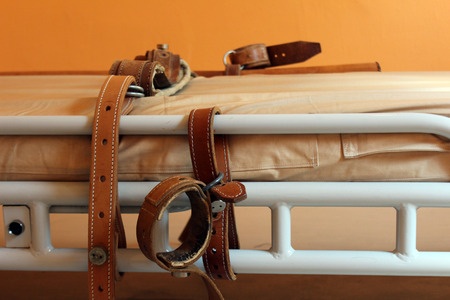
 The terror experienced by those forcibly restrained in a psychiatric ward can have a deep and lasting impact on an already fragile and vulnerable person. From the patient’s perspective, if they don’t die, they certainly never forget a restraint experience.
[quote style=”1″ author=”Australian Patient”]When I was given treatment that involved being locked up, sedated [chemical restraint] and controlled, it was really like recreating my worst horrors and calling it treatment. Obviously it was about the least helpful thing that could have happened.1[/quote]
Former National Mental Health Commissioner, the late Ms Jackie Crowe, stated in 2015,
[quote style=”1″]There is a lack of evidence internationally to support seclusion and restraint in mental health services. There is strong agreement that it is a human rights issue, that it has no therapeutic value, that it has resulted in emotional and physical harm….2[/quote]
All Australian states have legislation that prohibit cruelty to animals. Cruelty to an animal in most states3 includes: to abuse, torment or terrify the animal and in Qld and Vic it also includes to worry an animal.4 Penalties for individuals found guilty depends on the state but as an example, in Western Australia if someone is cruel to an animal it carries a maximum penalty of $50,000 and imprisonment for 5 years5. Yet if somebody in Western Australia ill-treats a psychiatric patient it carries a maximum penalty of only $24,000 and imprisonment for 2 years6 – significantly less than the penalty for being cruel to an animal.
Restraint is criminal and it must be made a criminal offence if performed on a psychiatric patient or someone allegedly mentally ill.
What is Restraint?
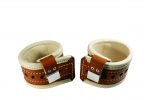
Restraint can be administered in several ways:
- Physical–being held or restrained down by another person/s
- Chemically induced–the use of psychiatric drugs to subdue and control or
- Mechanical. Mechanical restraint is the application of devices (including belts, harnesses, manacles, sheets and straps) on a person’s body to restrict his or her movement.7
It is well-known within psychiatric circles to have zero therapeutic benefits and instead can greatly increase trauma.8
United Nations Says Restraint is Torture

As long ago as 2013 damning comments by the United Nations Special Rapporteur on Torture and Other Cruel, Inhuman or Degrading Treatment or Punishment, leave no doubt as to the cruelty of restraint:
[quote style=”1″ author=”Mr. Juan E Méndez”]Furthermore, deprivation of liberty that is based on the grounds of a disability and that inflicts severe pain or suffering falls under the scope of the Convention against Torture. In making such an assessment, factors such as fear and anxiety produced by indefinite detention, the infliction of forced medication or electroshock, the use of restraints and seclusion, the segregation from family and community, should be taken into account.
The mandate has previously declared that there can be no therapeutic justification for the use of solitary confinement and prolonged restraint of persons with disabilities in psychiatric institutions; both prolonged seclusion and restraint constitute torture and ill-treatment. In my 2012 report (A/66/88) I addressed the issue of solitary confinement and stated that its imposition, of any duration, on persons with mental disabilities is cruel, inhuman or degrading treatment.” 9[/quote]
Restraint Can Cause Death
 A NSW Health Policy Directive states, “There have been instances both in Australia and internationally in which young apparently healthy people have died suddenly while held in physical/manual restraint. Resuscitation attempts in these circumstances have rarely been successful. Most deaths have been attributed to positional asphyxia or cardiac arrest. While some deaths involved apparent pressure to the neck, thorax or abdomen, the inappropriate application of restraint does not always appear to be a factor.” 10
- An involuntarily detained patient at Graylands hospital in Western Australia repeatedly told staff restraining him to let him go and said, “You are going to kill me,” moments before he slumped to the ground and died. A post mortem found significant bruising on his neck and that death was consistent with cardiac arrhythmia during restraint.11
- Dr Minh Le Cong who works for the Royal Flying Doctor Service in Queensland, in a 2017 article in Medical Journal of Australia InSight, detailed specifics of 4 of the many restraint deaths that have occurred in Australia. Two of the deaths were linked to the excessive use of the benzodiazepine midazolam as a chemical restraint. The third person who died was given the antipsychotic olanzapine and then midazolam and the fourth person was physically restrained and given midazolam.12
- Former Austin Hospital Director of Mental Health Dr Richard Newton said he would estimate one death in circumstances involving restraint, forced sedation and seclusion each year in Victoria alone.13
The Lack of Mandatory Reporting
 Abuse with the use of restraint is rife, yet remains hidden from public scrutiny due to a lack of mandatory reporting required by law in every state of Australia. For example for 2019-20; ACT did not report on mechanical restraint, and chemical restraint was not reported on by anyone.14 Also there is a lack of appropriate action taken when reports are released.
The reporting of chemical restraint is not addressed adequately, if at all in various state mental health acts and there is clear evidence that the use of drugs to restrain patients is rampant.
The 2019-20 Australian Institute on Health and Welfare’s Mental Health Services in Australia Report, reveals there were:
- 18,352 physical restraint events nationally.15
- 1,213 mechanical restraint events nationally.16
- Regarding children and adolescents, the rate of mechanical restraint was 250%17 higher than the previous year and the rate of physical restraint was 12.8%18 higher than the previous year.
The reporting of chemical restraint is not addressed adequately, if at all in various state mental health acts and there is clear evidence that the use of drugs to restrain patients is rampant.
Restraint is Criminal
 Restraint is criminal and it must be made a criminal offence. It is unacceptable that people in mental health facilities are subjected to this cruel treatment which often worsens their condition. It is unconscionable that those who cause harm or death of someone with the use of restraint are not criminally charged.
With $10.6 billion spent on mental health in Australia in 2018-19, allocated to provide the “best possible care,” psychiatry is still relying on violence to enforce its will.19 The philosophy behind it is an ingrained mentality from psychiatry’s earliest days of the mental asylums in Bedlam that the mentally ill are somehow lesser people and must be forced into abusive treatments.
There are valid ways to calm and work with traumatised people that preclude the need for harsh and inhumane treatment. Often when patients are treated abruptly, harshly and their opinions ignored, they become more fearful and aggressive.
A 2017 NSW review of restraint and seclusion in mental health facilities report states,
[quote style=”1″]It is not unusual for staff to raise concerns that staff and consumer safety will be compromised if seclusion and/ or restraint are reduced, but this concern is not supported by the weight of evidence.20[/quote]
Psychiatric drugs are known to cause aggression and violence and their role in contributing to violence in psychiatric wards requires a full government investigation in each state to protect both patients and staff. To learn more about how psychiatric drugs can cause violence read, Psychiatric Drugs: Create Violence & Suicide.
Is there progress on banning restraint?
As a result of the Royal Commission into Aged Care Quality and Safety, in 2020, the Aged Care Act’s Quality Care Principles for Elderly was amended. Aged Care Providers who receive payment from the Commonwealth Government for their residents must now obtain consent from the elderly person it is proposed to restrain or their representative before both chemical and physical restraint can be used (unless it is an emergency).21 These legally enforceable improvements are in use.22
We need full and complete transparency on restraint. Considering the trauma restraint produces, a ban on restraint with criminal fines and prison terms for its use, is called for. Only in this way can patient’s rights be restored, with real compassion and human rights brought to fruition.
What can you do?
 There are no bans anywhere in Australia’s state mental health acts to prevent the use of restraint including on children, pregnant women and the elderly. While this is being addressed, minimally in the event that restraint results in death or physical damage, any psychiatric staff member and the psychiatrist who authorised the restraint should be made criminally responsible under the law.
Add your voice to the call for the ban of restraint:
- Contact your local Member of Parliament, Health Minister and Mental Health Minister and ask them to make changes to your state’s mental health act so that restraint is made illegal and a criminal offence if performed on a psychiatric patient or someone allegedly mentally ill. Ask others to do the same.
To find the contact details for your local Member of Parliament and Health Minister:
ACT: https://www.parliament.act.gov.au
NSW: https://www.parliament.nsw.gov.au/members/Pages/all-members.aspx
NT: https://parliament.nt.gov.au/members/by-name
Qld: https://www.parliament.qld.gov.au/members/current/list
SA: http://www.parliament.sa.gov.au/Members/Pages/Members.aspx
Tas: http://www.parliament.tas.gov.au/ha/halists.pdf and http://www.parliament.tas.gov.au/lc/lclists.pdf
Vic: https://www.parliament.vic.gov.au/about/people-in-parliament/members-search/list-all-members
WA: http://www.parliament.wa.gov.au/parliament/memblist.nsf/wallmembers
To learn more about restraint read CCHR’s booklet, Deadly Restraints online or contact CCHR Australia for a free copy.
References
- “Warning on restraint tactics in mental health care,” ABC Radio, AM Program, 5 Jan.2016
- Margaret Scheikowski, AAP, “Call to reform mental health practices,” The Australian, 29 May 2015.
- NSW Prevention of Cruelty to Animals Act 1979. As at 23 September 2020. p10. https://www.legislation.nsw.gov.au/view/html/inforce/current/act-1979-200; Qld Animal Care and Protection Act 2001 Current as at 1 July 2016. P21. https://www.legislation.qld.gov.au/view/pdf/2016-07-01/act-2001-064 ; ACT Animal Welfare Act 1992 A1992-45. Republication No 31. Effective: 10 April 2020. p5 in pdf. https://www.legislation.act.gov.au/a/1992-45 : TAS Animal Welfare Act 1993 Version 1 July 2019. Sec 8.(2)(a) https://www.legislation.tas.gov.au/view/html/inforce/current/act-1993-063 : VIC Prevention of Cruelty to Animals Act 1986 p17 https://content.legislation.vic.gov.au/sites/default/files/08febf3f-607b-3f8f-b3df-92028dee2fc1_86-46aa095%20authorised.pdf
- VIC Prevention of Cruelty to Animals Act 1986 p17 https://content.legislation.vic.gov.au/sites/default/files/08febf3f-607b-3f8f-b3df-92028dee2fc1_86-46aa095%20authorised.pdf : Qld Animal Care and Protection Act 2001 Current as at 1 July 2016.P21. https://www.legislation.qld.gov.au/view/pdf/2016-07-01/act-2001-064
- Western Australia Animal Welfare Act 2002. As at 22 Feb 2019. Sec 19.(1) https://www.legislation.wa.gov.au/legislation/prod/filestore.nsf/FileURL/mrdoc_41795.pdf/$FILE/Animal%20Welfare%20Act%202002%20-%20%5B02-a0-01%5D.pdf?OpenElement
- Section 253. Western Australia Mental Health Act 2014. As at 01 Dec 2018 Version 01-g0-02 Published on www.legislation.wa.gov.au https://www.legislation.wa.gov.au/legislation/statutes.nsf/main_mrtitle_13534_homepage.html
- “National Principles to Support the Goal of Eliminating Mechanical and Physical Restraints in Mental Health Services,” Australian Health Ministers Advisory Project, 15 Dec. 2016. http://www.apha.org.au/wp-content/uploads/2017/05/Att-A-Nat-Principles-mechanical_physical-_restraint-2.pdf
- “Minimising the use of seclusion and restraint in people with mental illness,” RANZCP, Position Statement 61, Feb.2016. https://www.ranzcp.org/News-policy/Policy-submissions-reports/Document-library/Minimising-the-use-of-seclusion-and-restraint-in-p
- UN Human Rights Council, Report of the Special Rapporteur on torture and other cruel, inhuman or degrading treatment or punishment, 1 February 2013, A/HRC/22/53
- “Aggression, Seclusion & Restraint in Mental Health Facilities in NSW,” NSW Health Policy Directive, next Review Date for this publication is 31 December 2019, (original publication date: Date 26 June 2012), p. 9.
- “’Misadventure’ as psychiatric patient died,” WA Today, 22 Nov.2011 https://www.watoday.com.au/national/western-australia/misadventure-as-psychiatric-patient-died-20111122-1nsoc.html
- Minh Le Cong, “Chemical restraint or lethal injection?” MJA InSight, 6 March 2017. https://www.doctorportal.com.au/mjainsight/2017/8/chemical-restraint-or-lethal-injection/
- Joel Magarey, “Deaths, injuries, trauma the fallout from psychiatric practices,” The Australian, 26 July 2013. https://www.theaustralian.com.au/news/health-science/deaths-injuries-trauma-the-fallout-from-psychiatric-practices/news-story/1e1be5ae62150c5fa23a8424ddf7ddbf?sv=73a16caf5355f8475c6d8b2718e55896;
- “Mental Health Services in Australia,” web report last updated 18May 2021. https://www.aihw.gov.au/reports/mentalhealth-
services/mental-health-services-in-australia/report-contents/restrictive-practices/restraint - Table RP.8: Restraint rate, public sector acute mental health hospital services, states and territories, 2015–16 to 2019–20. Row 6 – Number of physical restraint events; Column G. https://www.aihw.gov.au/getmedia/44d86d6e-dea1-48c1-9e85-faf0152836df/Restrictive-practices-tables-2019-20.xls.aspx
- Table RP.8: Restraint rate, public sector acute mental health hospital services, states and territories, 2015–16 to 2019–20. Row 5 – Number of mechanical restraint events; Column G. https://www.aihw.gov.au/getmedia/44d86d6e-dea1-48c1-9e85-faf0152836df/Restrictive-practices-tables-2019-20.xls.aspx
- Table RP.9: Restraint rate, public sector acute mental health hospital services, by target population, 2015–16 to 2019–20. Row 6 – Rate of mechanical restraint; Child and adolescent. Column F & G. https://www.aihw.gov.au/getmedia/44d86d6edea1-48c1-9e85-faf0152836df/Restrictive-practices-tables-2019-20.xls.asp
- Table RP.9: Restraint rate, public sector acute mental health hospital services, by target population, 2015–16 to 2019–20.
Row 11 – Rate of physical restraint; Child and adolescent. Column F & G. https://www.aihw.gov.au/getmedia/44d86d6edea1-48c1-9e85-faf0152836df/Restrictive-practices-tables-2019-20.xls.aspx - “Mental Health Services in Australia,” web report last updated 18 May 2021. https://www.aihw.gov.au/reports/mentalhealth-services/mental-health-services-in-australia/report-contents/restrictive-practices/restraint
- “Review of seclusion, restraint and observation of consumers with a mental illness in NSW Health facilities, NSW Government, December 2017, p.II. https://www.health.nsw.gov.au/mentalhealth/reviews/seclusionprevention/Pages/about.aspx
- “Quality of Care Principles 2014, made under section 96-1 of the Aged Care Act 1997,” 96-1 Principles, 4 Feb 2020, s15F & s15 G. See also the following in Aged Care Act: Chapter 7, Division 96- Miscellaneous, 96-1, Division 54- Quality of care, 54-1, Division 23A- Introduction, 23A-1 & 23B-, Division 41-Introduction, 41-1.
- Mathew Newton, “Commission finds Blue Care Toowoomba used chemical restraints without consent,” The Chronical, 6 October 2020. https://www.thechronicle.com.au/news/toowoomba/commission-finds-blue-care-toowoomba-usedchemical-restraints-without-consent/news-story/2c8bb1655bf3f01eb76b4b97d68cd945